
Cache Warrant Checks
Cache counted 2,930 residents in the 2020 Census, third in the ranking used here. Population does not decide where a warrant record lives. A Cache municipal citation belongs to the city court, and the official page gives the clerk line at 580-429-3354, extension 2, plus a mail route of P.O. Box 466, Cache, OK 73527. City Hall sits at 404 West C Street. When you call, ask whether the citation carries an FTA warrant, what payment or appearance step clears it, and how the city confirms a recall. Payments run by mail, phone, online, or in person. No public search field lists every name with an outstanding warrant, so the clerk's word settles the FTA question.
- Read the Cache court and citation number.
- Call extension 2 before using an online payment route.
- Ask whether proof of insurance changes the citation.
- Use Cache Police only for a police-record request or emergency direction.
- Move to county offices only when the notice is a District Court or Sheriff matter.
Cache Warrant Offices and Courts
Cache Municipal Court and Cache Police do different jobs. The court covers city ordinance, traffic, nontraffic, and parking matters. Police records, by contrast, take written requests with the name, date, location, and nature of the incident, plus a self-addressed envelope and fees for copies. Those fees buy police records, not a court warrant payment.
Cache Municipal Court
Clerk route, P.O. Box 466, Cache, OK 73527
580-429-3354 ext. 2
Send a court question to the clerk, not a police records form.
Warrants in Cache: The Main Types
Cache's public court language centers on local ordinance and traffic obligations. Miss a date and an FTA can add fines, fees, and a warrant. A county bench or arrest warrant runs through a different District Court route, while a federal warrant is separate again.
| Cache matter | Trigger | First route |
|---|---|---|
| Traffic or parking | Missed appearance or unpaid city obligation. | Cache Municipal Court. |
| FTA warrant | Failure to appear at the required city setting. | Clerk extension 2. |
| Police record | Incident or call record request. | Cache Police records office. |
| County case | District Court filing or county process. | Court Clerk and Sheriff Records. |
Cache Court Warrant Consequences
Cache calls its municipal court a "court not of record." That phrase describes its status, not its reach. The court still has a clerk, a file, and real power to impose local consequences. Its page sets out jurisdiction, FTA warnings, payment routes, and a direct clerk extension. Treat the wording with care. It gives no reason to send a Cache ticket to OSCN, and it does not mean the Sheriff's Most Wanted page will carry a city warrant. For a Cache citation, the city clerk answers best. The court's own page shows the city's record path.
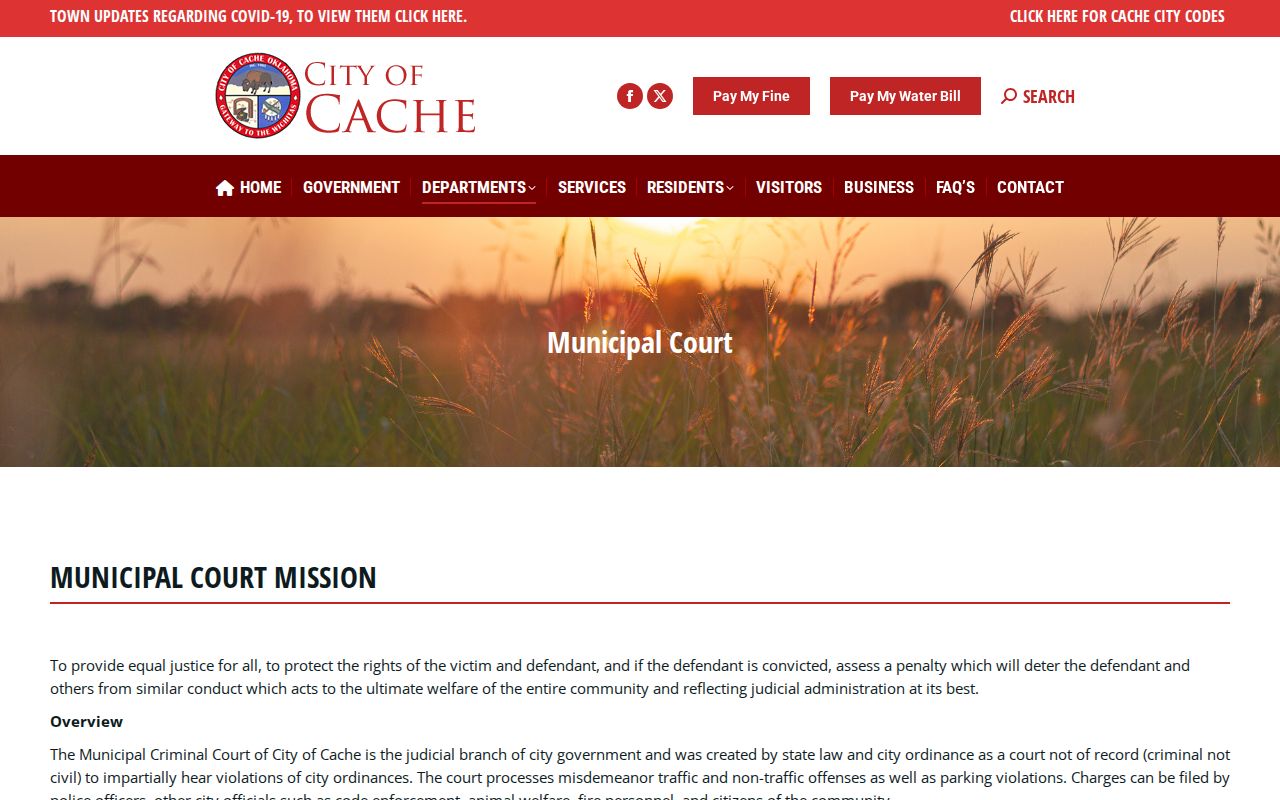
A local court page can be useful without offering a public name search.
Cache Warrant Records: What They Show
Cache publishes no uniform public warrant field list. Have the citation, court date, party name, and any proof-of-insurance paper ready. Then ask the clerk for the current total, the FTA status, the payment route, and whether an appearance is required.
| Citation number | Use the ticket identifier, such as CACHE-TR-2026-01 as an example only. |
|---|---|
| Municipality | Cache Municipal Court controls city-code matters. |
| FTA event | May explain additional fees and a warrant. |
| Proof of insurance | Ask whether it changes a reducible or adjustable charge. |
| Payment status | Phone, mail, online, or in-person action may need clerk confirmation. |
Why Cache Payment Is Not a Warrant Search
A payment screen is not a warrant search. The Cache court page links its payment routes, but no public database there searches by name. Clearing a citation may take a number, a clerk conversation, an appearance, proof of insurance, or a judge's action. Phone and online payments can carry convenience charges. Call extension 2 before sending money if the citation may be in warrant status. Ask how the city records a recall, and whether a payment reaches the court the same day. Keep the receipt and any written instruction. Police dispatch is not the place for a court balance, and a crime-tip form will not answer a records question.
Cache Warrant and Insurance Questions
Cache's municipal page covers proof-of-insurance and reducible-charge information. That detail can matter for a traffic citation, but it does not by itself establish that a warrant is recalled. Ask the clerk which document is accepted, whether an appearance still applies, and what follows the adjustment. The police records page is separate and lists per-page, certified-copy, hourly, and CD charges for police material. None of those figures is a Cache warrant fee.
Cache Warrants and Comanche County
A Cache municipal warrant starts in the city court, with Cache Police handling service. It does not turn into a District Court record on its own. For a county case, search OSCN or call the Court Clerk criminal office at 580-355-4017. For Sheriff-held county information, use 580-353-4280. The Comanche County warrant records home maps the wider route. The 2015 Oklahoma DPS municipal export lists a Cache code, but its age makes it historical context, not a current portal or court calendar.
Cache Warrant Police-Records Fees
Cache Police's records page wants a written request with every detail you can give: name, date, location, and nature, plus the fee and a self-addressed envelope for mail. Charges cover calls or logs, accident reports, certified copies, extended searches, and a CD. These are police-record fees, not the cost of resolving a municipal warrant. The city's 911 and dispatch setup serves Cache and surrounding county areas, but dispatch does not adjudicate a warrant. Use 911 for emergencies, police records for incident copies, and Municipal Court for a citation. The police page itself shows that records context.
Separate request types keep a court status question on the right route.
Clearing a Cache Warrant
Ask the clerk whether Cache accepts payment, wants proof of insurance, requires a judge appearance, or sets a new date. The city publishes no universal motion form, recall fee, or after-hours surrender rule. Lawton's procedure does not apply here.
Before action: Confirm the citation, amount, accepted method, court setting, and how the city will mark the warrant cleared.
If custody is involved, the county Detention Center uses 580-250-1902. Its weekend bond schedule excludes a warrant, except for a bogus-check warrant. That county rule never replaces Cache Municipal Court.
Cache Warrant Terms
In Cache, “FTA” is shorthand for failure to appear, and “failure to pay” means a court amount went unpaid. “Court not of record” describes the city’s municipal standing. A recall happens when the issuing court withdraws its process, and a police record alone is not a court warrant record.
- Clerk extension 2
- The published Cache Municipal Court contact route.
- Police records
- Incident or call records held by the police records office.
- City warrant
- Process tied to a Cache ordinance or traffic matter.
- County warrant
- Process tied to District Court or Sheriff records.
Use the office name and citation to keep the terms straight.
Accessing Cache Warrant Records
Oklahoma’s Open Records Act sets the basic rules for inspection and copies, though exemptions apply. Cache’s court and police pages handle requests differently. Juvenile, sealed, protected, investigative, county, or federal files will not open through a city web page.
Access rule: Title 51 §24A.5 supports public access subject to legal limits. Ask Cache Municipal Court about court material and Cache Police about police records.
A blank payment or search result is not a final warrant answer.
Cache Warrant Questions Before Payment
Before paying anything in Cache, ask the clerk whether the ticket sits in warrant status, whether proof of insurance changes the case, and whether a judge must act. Confirm current payment methods and any convenience charge. Ask when the city confirms a recall. Keep your citation, receipt, and the clerk’s response. Cache shows why local detail matters. The court, the police records office, the county clerk, the Sheriff, and the 911 center may each hold a different piece of the answer.